
Bigger Than the Numbers? Dancehall’s Crown Debate Is Really About Who Gets Counted
By Dante Jackson, Entertainment Editor
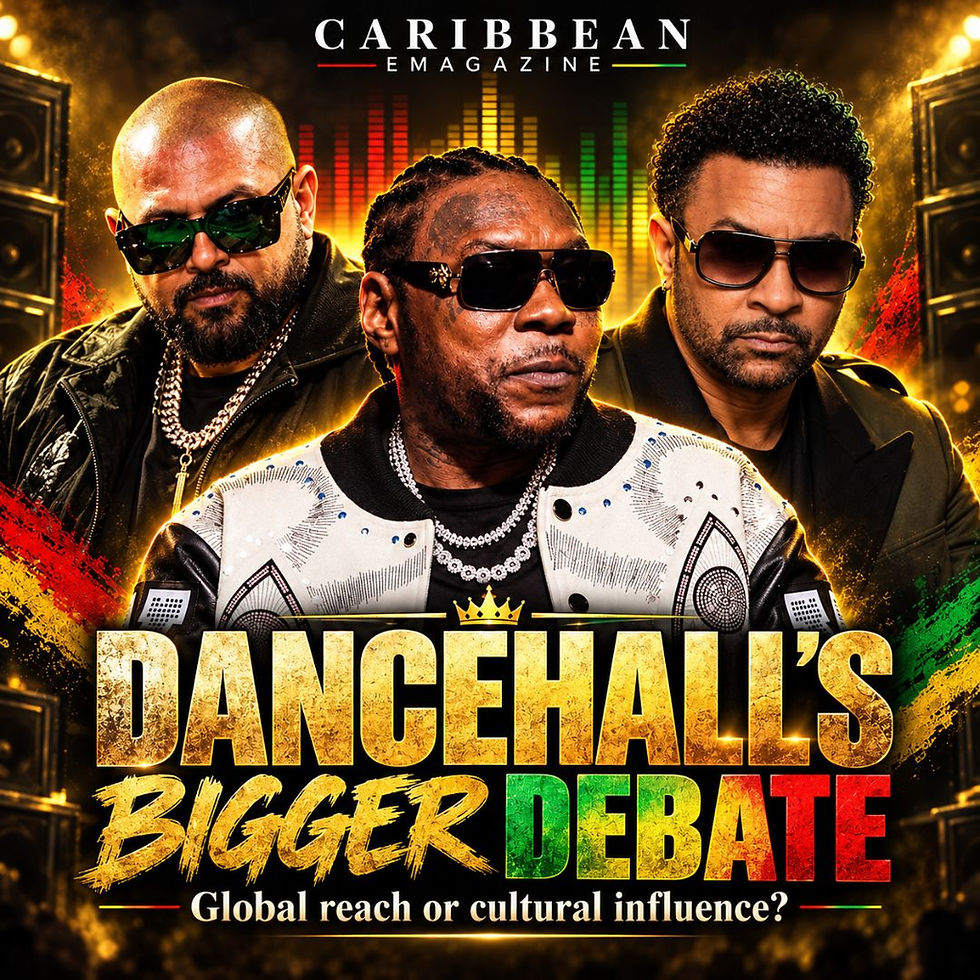
The latest debate over who stands tallest in Jamaican music has all the ingredients of a social media storm: a bold claim, a sharp clapback and Bob Marley’s name pulled into the conversation. But beneath the back-and-forth between Shaggy and Vybz Kartel is a more complicated question: when we call an artist “bigger,” whose definition of success are we using—and whose audience are we seeing?
In a recent interview, Shaggy argued that dancehall has produced more than one king. He pointed to artists who shaped different eras, while placing himself, Sean Paul and Bob Marley among Jamaica’s most internationally recognised names. Kartel answered with a pointed social media caption, seemingly calling Shaggy a “manufactured pop star with little talent and no influence on the culture.” The exchange quickly became a proxy battle between global reach and cultural influence.
Then Bob Marley entered the argument in an even bigger way. Producer Cordel “Skatta” Burrell suggested that Kartel’s story and legacy could eventually eclipse Marley’s, a comparison that predictably set off fierce reactions. That is a sweeping prediction, and Marley’s worldwide cultural legacy is not something that can be settled by a provocative interview clip or a hypothetical film. But the reaction also revealed how quickly discussion of Kartel’s influence becomes a referendum on who is allowed to stand beside Jamaica’s most enduring musical icon.
Here is the uncomfortable part: Shaggy and Sean Paul are often judged through the complexion of their audiences. Their crossover success has carried them into pop markets, international radio and listeners who may not speak patois or know every dancehall reference. Some people treat that reach as evidence that their music is less connected to the culture. Others look at Kartel’s predominantly Jamaican, Caribbean and Black grassroots following and see proof of a deeper cultural hold. Both readings can miss something. A diverse global audience does not make an artist less Jamaican, and a deeply local following does not make an artist less influential.
The word “bigger” is doing too much work. Bigger by record sales? Chart positions? Streaming? Concert attendance? Influence on the sound, language and style of dancehall? The ability to command attention at home, across the diaspora or in markets where Jamaican music is not the dominant sound? Those are different measures, and they do not always point to the same artist. Shaggy’s case rests heavily on international success and longevity. Sean Paul has taken dancehall-inflected records to a vast global audience. Kartel’s influence is often felt more directly in dancehall’s language, sound and generational identity. These accomplishments can coexist without being interchangeable.
That difference deserves a conversation about race and class, too. When an artist’s audience is more visibly rooted in Black Jamaican and Caribbean communities, that connection can be praised as authenticity—or used to limit how far the artist is considered to have reached. When an artist crosses over to a broader, whiter or less culturally specific audience, that reach can be celebrated as universal—or dismissed as selling out. If we use “culture” to mean only grassroots recognition, we risk shrinking the culture to one audience. If we use “bigger” to mean only international numbers, we risk treating mainstream visibility as the sole proof of importance.
And none of this requires tearing down Shaggy to make room for Kartel, or diminishing Sean Paul to defend Shaggy. All three are gifted artists who have contributed to Jamaican music in distinct ways. Their routes are different because their careers, eras, sounds and audiences are different. That is precisely why the comparison keeps igniting: fans are not only defending artists; they are defending their own idea of what Jamaican music should represent.
Bob Marley’s place in the story should not be reduced to a prize in a modern fan argument. His work reached far beyond Jamaica and became part of a global language of music, identity and resistance. Kartel’s immense influence on contemporary dancehall is real, but it does not have to be measured by declaring him Marley’s replacement. Nor does Shaggy’s crossover success erase his Jamaican roots. A culture with a history as rich as Jamaica’s can hold multiple kinds of greatness at once.
So is this really about who is bigger in dancehall—or about who is listening? It is about both, and about who gets to decide which listeners count. Dancehall has always moved between the street and the world, between local sound systems and international stages. The genre does not need one winner to prove its power. It needs room to recognise that Shaggy, Sean Paul, Kartel and Marley each reach people differently—and that difference is part of Jamaican music’s strength.


Comments