
Green Card Renewal Guide: How to Renew or Replace Your Permanent Resident Card
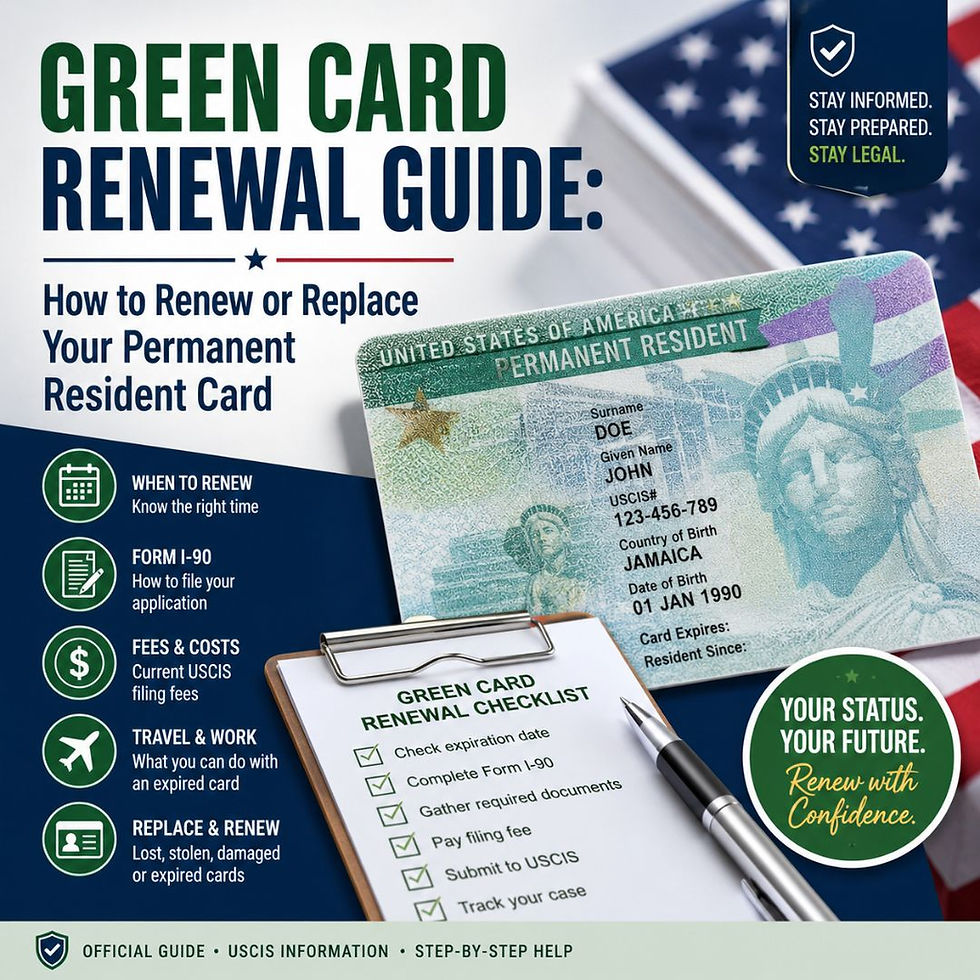
For millions of lawful permanent residents, a Green Card is one of the most important immigration documents they possess. Officially known as a Permanent Resident Card (Form I-551), it serves as evidence of lawful permanent resident status and can also be used to demonstrate authorization to live and work permanently in the United States.
But Green Cards do not necessarily last forever. Most modern Green Cards issued to lawful permanent residents are valid for 10 years, which means they eventually need to be renewed. Others may need to be replaced because they were lost, stolen, damaged, contained incorrect information, or because the holder's personal information changed.
If your Green Card is approaching its expiration date—or has already expired—understanding the renewal process can prevent unnecessary complications with employment, international travel, identification, and proof of immigration status.
Here is what permanent residents should know about renewing a Green Card.
When Should You Renew Your Green Card?
U.S. Citizenship and Immigration Services (USCIS) generally advises lawful permanent residents with a 10-year Green Card to renew it when the card has expired or will expire within the next six months. The standard application used for this process is Form I-90, Application to Replace Permanent Resident Card.
You may also need Form I-90 when your card has been lost, stolen, destroyed or damaged, when certain information needs to be changed, or when USCIS issued a card containing incorrect information.
Importantly, the expiration of a regular 10-year Green Card does not automatically mean that your lawful permanent resident status has expired. The card is evidence of your status; the expiration of the document itself is different from losing permanent resident status. Permanent resident status generally continues until it is abandoned, rescinded, terminated, or otherwise lost under immigration law.
That distinction is important, but permanent residents should still keep valid evidence of their status.
How to Renew a Green Card
Most permanent residents renewing a standard 10-year Green Card will use Form I-90.
USCIS allows eligible applicants to submit Form I-90 electronically or by mail. Filing online can make it easier to receive notifications, track the case, respond to certain USCIS requests and manage documents through a USCIS online account.
Applicants should always use the current version of Form I-90 and follow the current USCIS filing instructions rather than relying on an old copy of the form.
How Much Does Green Card Renewal Cost in 2026?
According to the current USCIS Fee Schedule available at the time of publication, the general Form I-90 filing fee is:
Online filing: $415
Paper filing: $465
Different fees or no fee may apply in certain circumstances. For example, some applications involving DHS errors or particular replacement situations may not require a filing fee, and certain applicants may qualify to request a fee waiver.
Immigration fees can change, so applicants should verify the amount immediately before submitting Form I-90.
Submitting the wrong payment can result in filing problems, so applicants should never rely solely on an old article, social media post or previously downloaded fee schedule.
What Happens After You File Form I-90?
After USCIS accepts a properly filed application, the agency issues a Form I-797 Notice of Action, commonly called a receipt notice.
Applicants should keep this document carefully.
USCIS currently provides a 36-month extension of Green Card validity for qualifying lawful permanent residents who properly file Form I-90 to renew an expiring or expired Green Card. The extension is measured from the expiration date printed on the Green Card.
The receipt notice, when presented together with the expired Green Card, can serve as evidence of continued lawful permanent resident status during the extension period. USCIS states that the combination may also be used as evidence of employment authorization and authorization to return to the United States following temporary foreign travel.
This is one reason applicants should not discard their expired Green Card after filing for renewal.
Will You Need a Biometrics Appointment?
Possibly.
USCIS reviews Form I-90 applications to establish the applicant's identity and permanent resident status and to ensure applicable biometric and security requirements have been completed. USCIS may schedule an applicant for biometrics or may otherwise process the applicable biometric requirements using information available to the agency.
Applicants should carefully follow any appointment or other instructions contained in notices from USCIS.
Failure to satisfy required biometrics, identity, interview or other eligibility requirements can result in denial of Form I-90.
Can You Work With an Expired Green Card?
An expired Green Card does not, by itself, automatically terminate lawful permanent resident status. For qualifying renewal applicants, the expired Green Card presented together with the Form I-90 receipt notice showing the USCIS extension can serve as evidence of permanent resident status and employment authorization during the applicable extension period.
Employment verification situations can be highly document-specific, however, so permanent residents should make sure they are relying on current USCIS requirements rather than assuming that an expired card by itself will always be sufficient.
Can You Travel With an Expired Green Card?
International travel requires more caution.
USCIS states that the Form I-90 receipt notice extending the validity of a Green Card, when presented with the expired card, may be used as evidence of authorization to return to the United States after temporary foreign travel.
Travelers should carry both documents when relying on the extension.
If you do not have your Green Card—for example, because it was lost or stolen—the situation is different.
A lawful permanent resident temporarily outside the United States for less than one year who does not possess a valid Green Card may, depending on the circumstances, need to file Form I-131A, Application for Carrier Documentation, to obtain documentation demonstrating to an airline or other transportation carrier that the individual is authorized to travel to the United States.
International travel can also raise separate questions about maintaining permanent residence, particularly after lengthy absences from the United States. Renewing a Green Card does not resolve issues involving possible abandonment of permanent residence.
What If You Need Proof of Status Before Your New Card Arrives?
Some permanent residents need stronger temporary evidence of status while their replacement Green Card is pending.
USCIS can provide temporary evidence of permanent resident status in certain circumstances through an Alien Documentation, Identification and Telecommunication (ADIT) stamp, commonly called an I-551 stamp.
For example, someone who does not possess their Green Card may need temporary evidence for employment or travel. An applicant whose Form I-90 remains pending after the card and applicable extension documentation expire may also request temporary evidence of status.
USCIS determines whether an ADIT stamp or other temporary evidence should be issued based on the circumstances.
Lost or Stolen Green Card? Renewal Is Not the Only Reason to File I-90
Form I-90 is called the Application to Replace Permanent Resident Card because it covers much more than ordinary expiration.
A lawful permanent resident may need to file Form I-90 if a Green Card has been:
Lost, stolen or destroyed;
Damaged or mutilated;
Issued with incorrect information;
Affected by a legal name or other biographical change; or
Reached expiration or is approaching expiration under the applicable renewal rules.
Supporting documents vary according to the reason for filing. For example, an applicant seeking correction of information caused by a DHS error must provide evidence of the correct information and follow USCIS instructions concerning the incorrect card.
The Biggest Mistake: Do Not Use Form I-90 to Renew a Two-Year Conditional Green Card
One of the most important distinctions in the Green Card process involves conditional permanent residents.
If your Green Card is valid for only two years because permanent residence was granted conditionally through marriage or qualifying investment, you generally should not file Form I-90 simply to renew the card when the conditional status is approaching expiration.
A marriage-based conditional permanent resident generally files:
Form I-751, Petition to Remove Conditions on Residence
An investor-based conditional permanent resident generally files:
Form I-829, Petition by Investor to Remove Conditions on Permanent Resident Status.
USCIS instructions state that conditional permanent residents whose two-year status is expiring within 90 days are not eligible to use Form I-90 to replace the card on that basis. They must use the appropriate petition to remove conditions.
This distinction is critical. A 10-year Green Card renewal and removal of conditions from a two-year Green Card are different immigration processes.
What If Your Green Card Has Already Expired?
Do not assume that it is too late to renew simply because the expiration date has passed.
Form I-90 specifically covers lawful permanent residents whose cards have already expired as well as cards approaching expiration.
You should generally file the appropriate application as soon as possible rather than allowing the situation to continue unnecessarily.
However, if there are additional immigration complications—such as lengthy residence outside the United States, removal proceedings, questions about abandonment of permanent residence or uncertainty about your immigration status—it may be wise to speak with a qualified immigration attorney before assuming that a routine I-90 renewal is all that is required.
What If USCIS Denies Your Green Card Renewal?
USCIS may deny Form I-90 if an applicant cannot establish permanent resident status or identity, fails to satisfy biometric requirements, fails to attend a required interview, or otherwise fails to establish eligibility for the requested replacement card.
There is generally no direct appeal from a Form I-90 denial. However, depending on the circumstances, an applicant may be able to file Form I-290B, Notice of Appeal or Motion, seeking a motion to reopen or reconsider, or may submit a new Form I-90 if eligible.
A denial involving questions about the person's underlying permanent resident status should be taken seriously.
Should You Renew Your Green Card If You Are Eligible for U.S. Citizenship?
This is another common question.
Some permanent residents who have held Green Card status for years may already qualify to apply for naturalization.
USCIS provides a separate extension for certain naturalization applicants. A lawful permanent resident who properly files Form N-400, Application for Naturalization, receives an N-400 receipt notice that, when presented with the Green Card, extends the card's validity for 24 months from the expiration date.
That means someone who is already eligible for citizenship should consider their circumstances before automatically assuming that filing Form I-90 is their only option.
Naturalization eligibility depends on much more than simply having held a Green Card for a certain number of years, however. Continuous residence, physical presence, good moral character and other requirements may apply.
Common Green Card Renewal Mistakes to Avoid
Several preventable mistakes can complicate an otherwise straightforward renewal.
Waiting until the last minute: Starting the process when your card is within the recommended renewal window can reduce problems involving proof of status.
Using the wrong form: Form I-90 is generally for renewing or replacing a Permanent Resident Card. It is not the normal process for removing conditions from a two-year conditional Green Card.
Paying an outdated fee: Always check the current USCIS fee immediately before filing.
Failing to update your address: USCIS needs accurate contact and mailing information. A Green Card cannot be mailed to an address outside the United States.
Ignoring USCIS notices: Biometrics notices, Requests for Evidence and other correspondence may contain deadlines that can affect the application.
Throwing away your expired Green Card: Your expired card may need to be presented together with your Form I-90 receipt notice as temporary evidence of continued status.
Assuming renewal fixes other immigration problems: Form I-90 replaces evidence of permanent residence. It does not automatically resolve abandonment, removal proceedings, criminal immigration consequences or other underlying status issues.
Green Card Renewal Checklist
Before filing, make sure you:
Confirm that you have a regular 10-year Green Card rather than a two-year conditional card.
Check the expiration date on your current Green Card.
Determine the correct reason for filing Form I-90.
Use the current edition of Form I-90.
Gather the supporting documents required for your filing category.
Confirm the current USCIS filing fee.
Make sure your U.S. mailing address is correct.
Keep copies of everything submitted.
Save your Form I-797 receipt notice when it arrives.
Keep your expired Green Card with the receipt notice when relying on USCIS' extension.
Attend or comply with any biometrics or USCIS appointment requirements.
Check the status of your application while it remains pending.
Final Word
Renewing a Green Card is usually a straightforward administrative process, but choosing the wrong form, ignoring an expiring document or misunderstanding the difference between permanent and conditional residence can create unnecessary complications.
For most lawful permanent residents with a standard 10-year Green Card, the key document is Form I-90. USCIS generally recommends renewal when the card has expired or will expire within six months, and qualifying renewal applicants currently receive documentation extending the validity of their expiring or expired Green Card for 36 months while Form I-90 is pending.
Most importantly, remember that an expired Green Card is not necessarily the same thing as expired permanent resident status. The card is evidence of status, and permanent resident status generally continues unless it has been abandoned, rescinded, terminated or otherwise lost under immigration law.
Because immigration rules, forms and filing fees can change, applicants should verify current requirements directly with USCIS before filing.
Disclaimer: This article is for general informational and educational purposes only and does not constitute legal advice or create an attorney-client relationship. Immigration cases can vary significantly based on individual circumstances. Anyone facing removal proceedings, extended international absences, criminal history, questions about abandonment of permanent residence, or other complicated immigration issues should consider consulting a qualified U.S. immigration attorney.


Comments