
How Reggae Changed Global Music: The Jamaican Sound That Influenced Hip-Hop, Punk, Afrobeats and Beyond
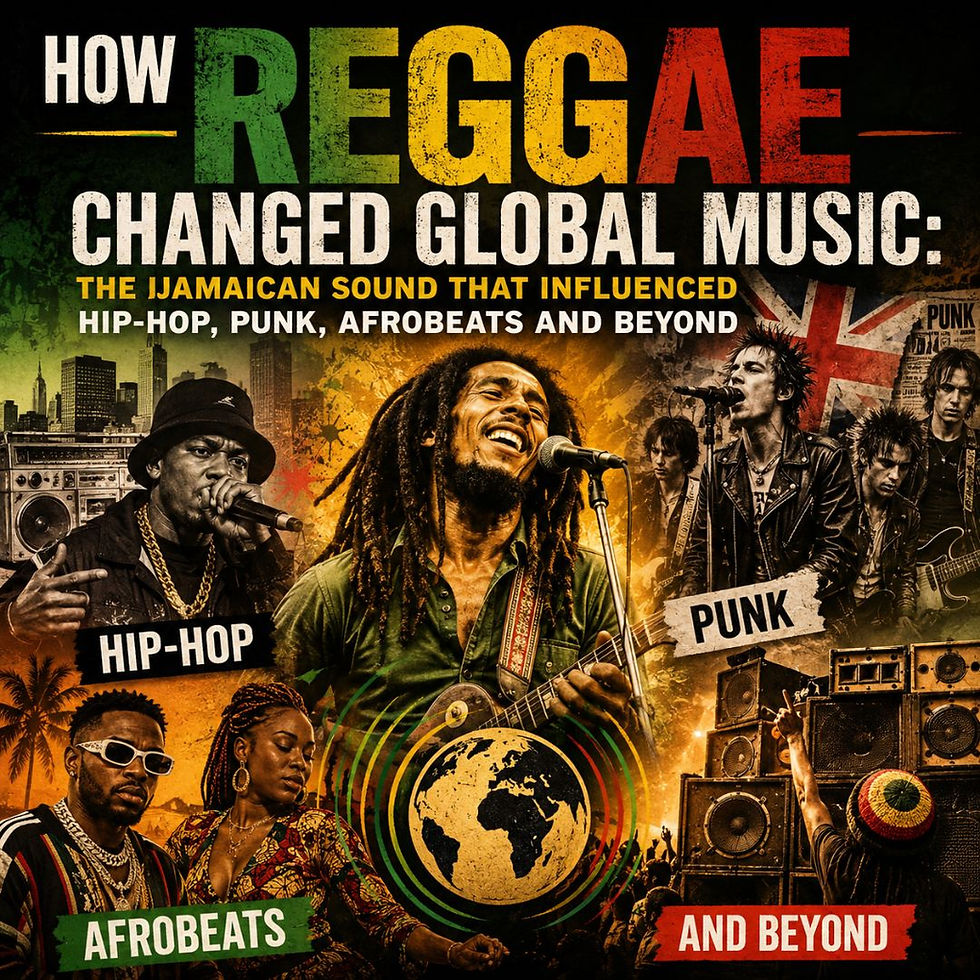
Reggae may have been born on a small Caribbean island, but its influence has never respected borders.
From the sound systems of Kingston to block parties in the Bronx, punk clubs in London, recording studios across Africa and today's global pop charts, Jamaica's musical innovations have travelled farther than almost anyone could have imagined. Reggae did more than introduce the world to a new rhythm. It helped change how music was produced, performed, distributed and even used as a vehicle for cultural identity and social commentary.
The story of reggae's global influence is therefore much bigger than a list of international artists who have recorded reggae-inspired songs. It is a story about Jamaica exporting an entire musical philosophy.
Reggae gave the world the bass-heavy groove, the sound-system experience, the riddim, the remix, the dub experiment and the charismatic deejay commanding the microphone. Those ideas became building blocks for genres that would eventually develop identities of their own.
Decades later, echoes of Jamaica can still be heard everywhere.
Reggae's Jamaican Roots Created a Global Musical Language
Reggae emerged in Jamaica during the late 1960s, developing from earlier Jamaican styles including ska and rocksteady. Its distinctive rhythmic approach—particularly the emphasis on the offbeat—combined with powerful basslines, drums, guitar and socially conscious lyrics to create a sound immediately recognizable around the world.
But Jamaican music was evolving beyond the records themselves.
Sound-system culture became an essential part of the country's musical ecosystem. DJs and selectors played records through enormous speaker systems at dances, while performers known as deejays developed rhythmic vocal styles over instrumental tracks.
Producers also began experimenting with recordings in increasingly imaginative ways.
Instrumental versions of songs were manipulated through echo, reverb, bass and studio effects, helping pioneers such as King Tubby and Lee "Scratch" Perry push dub into revolutionary territory.
The studio was no longer simply somewhere music was recorded. It became an instrument.
That concept would eventually become fundamental to electronic music production.
Meanwhile, reggae artists carried messages of resistance, spirituality, African consciousness, inequality and liberation around the world. Bob Marley became reggae's most internationally recognizable figure, but Jamaica's global musical footprint extends far beyond any single artist.
What Jamaica created was an ecosystem of sound. And other cultures began building upon it.
How Reggae Influenced Hip-Hop Culture
One of reggae's most important international connections can be found in hip-hop.
The relationship is especially significant because of Jamaican-born DJ Kool Herc, widely recognized as one of hip-hop's foundational figures.
Born Clive Campbell in Kingston before moving to New York, Herc became famous for parties in the Bronx during the 1970s. His approach to selecting records, using powerful sound equipment and extending instrumental breaks helped shape the environment from which early hip-hop developed.
The similarities between Jamaican sound-system culture and early hip-hop culture are difficult to ignore.
Both centered around DJs. Both depended heavily on speakers and public gatherings. Both created opportunities for performers to command audiences over recorded music. And both transformed existing recordings into something new.
Jamaican deejay culture also preceded the emergence of rap as a dominant American musical form. Artists such as U-Roy became famous for rhythmic vocal performances over existing riddims, a practice known as toasting.
Hip-hop developed within its own distinctly African-American and Latino cultural environment in New York, but Jamaica formed an important part of that larger story.
The connection eventually came full circle.
Dancehall embraced hip-hop influences, hip-hop artists sampled Jamaican records, and collaborations between American rappers and Jamaican artists became increasingly common.
Today, the relationship remains one of popular music's most fascinating cultural exchanges.
From Kingston to London: Reggae's Impact on Punk
Reggae's influence also became deeply embedded in British music.
Large Caribbean communities—particularly Jamaicans who settled in Britain during and after the Windrush era—brought sound-system culture, ska and reggae into British cities.
By the 1970s, reggae was increasingly intersecting with Britain's emerging punk movement. The connection was not simply musical.
Both reggae and punk frequently challenged established systems, confronted social inequality and provided rebellious young audiences with music that existed outside traditional expectations.
Bands including The Clash incorporated reggae and dub influences into their work, while Jamaican music became part of the soundtrack surrounding Britain's punk and post-punk scenes.
Later, groups such as The Police would achieve enormous international success incorporating reggae-influenced rhythmic elements into rock and pop. British ska revival movements further demonstrated Jamaica's influence. Bands associated with the 2 Tone movement—including The Specials and The Selecter—helped introduce new generations of British listeners to music heavily indebted to Jamaican ska and rocksteady. Jamaica's musical DNA had become woven into British popular culture.
Reggae's Influence on African Music
Reggae also developed an especially powerful relationship with Africa. That connection carried cultural and spiritual significance. Reggae's frequent celebration of African identity, Pan-Africanism and liberation resonated strongly across the continent, while Bob Marley's international prominence helped make reggae a soundtrack for freedom movements and post-colonial consciousness.
African musicians subsequently embraced reggae while adapting it to their own cultures and political realities. Artists including Alpha Blondy of Côte d'Ivoire and Lucky Dube of South Africa became internationally celebrated reggae performers, demonstrating that the genre could be localized without losing its Jamaican foundation.
Reggae's influence can also be heard within the wider evolution of contemporary African popular music.
Today's Afrobeats landscape is far too diverse to attribute to any single outside genre, but reggae and particularly dancehall have become important ingredients within the cross-cultural musical conversation connecting Africa and the Caribbean.
Modern African and Jamaican artists increasingly collaborate, blending dancehall, reggae, Afrobeats, amapiano and other sounds. What once travelled from Jamaica to Africa now moves continuously in both directions.
Reggae, Dancehall and the Rise of Global Pop
Perhaps the clearest evidence of Jamaica's influence can be heard in mainstream pop.
Reggae-inspired songs have repeatedly appeared on international charts, while dancehall rhythms and Jamaican vocal styles have become familiar ingredients in global hits. Artists outside Jamaica have frequently experimented with reggae, dancehall or Caribbean-influenced production. But the relationship has not always been uncomplicated.
As Jamaican sounds became commercially attractive internationally, debates emerged about cultural appropriation, proper credit and the tendency for global stars to benefit from Jamaican musical aesthetics while the creators and communities behind those sounds sometimes received less recognition.
That conversation remains important. Because Jamaican influence is not simply a production preset or rhythmic pattern. It comes from a living culture. Understanding the origin matters.
Reggae's Influence on Electronic Music and Remix Culture
One of Jamaica's greatest contributions to modern music may also be one of its least appreciated by mainstream audiences: dub.
Long before remix culture became standard throughout the music industry, Jamaican producers were rebuilding existing recordings.
Vocals disappeared.
Basslines moved forward.
Drums became enormous.
Echoes appeared and vanished.
Fragments of instruments moved around the recording.
Songs became completely different experiences.
Dub pioneers helped establish the idea that a producer could radically reinterpret a recording after the musicians had finished performing it.
That philosophy would influence electronic production techniques and remix culture around the world.
The relationship between Jamaican sound-system culture and electronic dance music is equally striking.
A selector or DJ controlling the musical journey.
Massive speaker systems.
Bass designed to be physically felt.
Exclusive recordings.
MCs interacting with crowds.
Sound clashes and competitive performance.
These characteristics existed within Jamaican culture long before many became familiar elements of global club and electronic scenes.
Even contemporary bass-heavy genres such as jungle and drum and bass developed within British environments where Jamaican sound-system and dub culture had significant influence.
The Jamaican "Riddim" Changed How Music Could Be Created
Another uniquely Jamaican innovation that foreshadowed modern music production was the riddim.
In reggae and dancehall, multiple artists can record completely different songs over the same instrumental foundation.
One riddim can generate dozens—or sometimes far more—individual recordings. That system challenged the traditional assumption that every song required an entirely unique instrumental arrangement.
Instead, creativity could come from interpretation.
Who could create the strongest melody?
Who could deliver the most memorable lyrics?
Who could transform the same instrumental into something audiences had never heard before?
Modern remix culture, beat licensing and producers creating instrumentals for multiple performers all have parallels with practices Jamaica developed decades earlier.
Reggae Became More Than Music
Reggae's influence cannot be measured only by sound. It changed global perceptions of Jamaica itself.
Through reggae, people thousands of miles from Kingston encountered Jamaican language, spirituality, fashion, food, politics and social history. Words and expressions rooted in Jamaican speech entered international popular culture. Rastafari became globally recognizable.
The colours red, gold and green became associated with reggae culture internationally.
Jamaican fashion and imagery travelled alongside the music.
Reggae therefore became one of Jamaica's most powerful forms of cultural diplomacy.
For millions of people, their first introduction to Jamaica was not through tourism.
It was through a record.
Reggae's Global Influence Is Still Evolving
The extraordinary thing about reggae is that its international influence is not simply historical.
It is still happening.
Reggae and dancehall continue interacting with hip-hop, R&B, Afrobeats, Latin music, electronic music and pop. Jamaican producers collaborate internationally, while artists across the Caribbean, Africa, Europe and the Americas continue borrowing, blending and reinterpreting Jamaican musical ideas.
The internet has accelerated those exchanges. A riddim created in Kingston can reach an artist in Lagos, London, Toronto or New York almost instantly. But as reggae becomes increasingly intertwined with global music, preserving the history behind the sound becomes even more important. Jamaica should not disappear from the story of the music it helped inspire.
How Reggae Changed Global Music—and Why Jamaica Still Matters
Few countries have influenced modern popular music as profoundly as Jamaica.
Reggae's greatest legacy may not simply be the international success of reggae itself. It is the extraordinary number of musical ideas Jamaica introduced that eventually became normal throughout the global industry.
Sound systems.
Deejays.
Toasting.
Dub.
Remixes.
Versions.
Riddims.
Bass-driven production.
Producer-led experimentation.
Music as resistance.
These were not passing trends.
They became part of the vocabulary of modern music.
Hip-hop transformed global culture. Electronic music created an enormous international industry. Afrobeats became a worldwide phenomenon. Punk changed rock. Dancehall continues influencing contemporary pop.
Each has its own history, innovators and cultural identity. But somewhere within many of those stories, Jamaica can be heard. Reggae began as the voice of a Caribbean nation expressing its reality to itself.
The world listened. Then the world started creating with it.


Comments