
Notting Hill Carnival 2026: 60 Years and Still Loud
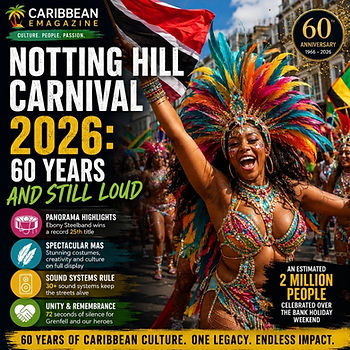
For one extraordinary Bank Holiday weekend, West London once again became one of the Caribbean diaspora’s biggest stages.
But Notting Hill Carnival 2026 was not just another Carnival.
Celebrating its 60th anniversary, the Diamond Jubilee edition carried the weight of six decades of Caribbean migration, resistance, creativity and cultural influence. From the first notes of steelpan at Panorama to the final hours of Monday’s massive Adults Day parade, Carnival reminded London—and the world—that what began as a community response to division has become one of the most powerful expressions of Caribbean culture outside the region.
An estimated two million people filled the streets over the weekend, according to reports following the celebration. And after 60 years, Carnival did not feel like a tradition simply looking backward. It felt alive.
From Community Celebration to Global Institution
The anniversary made the history behind the spectacle impossible to ignore.
The modern Notting Hill Carnival traces its street origins to 1966, when community activist and social worker Rhaune Laslett organised a children’s street party intended to bring together a neighbourhood dealing with racial tension, poor housing and social division.
The wider Carnival story is also inseparable from Caribbean activists, artists and communities who created cultural spaces in Britain amid racism and exclusion.
Sixty years later, those Caribbean foundations remain visible everywhere—in the steelpan orchestras, Trinidadian-style mas, Jamaican sound systems, calypso, soca, reggae, dancehall, food and flags filling the streets.
What started locally has become what organisers describe as Europe’s largest cultural event, while London officials estimate Carnival contributes roughly £400 million to the city’s economy. That growth makes Notting Hill one of the Caribbean diaspora's great cultural success stories. But its size is not what makes Carnival important. Its ownership of the streets does.
For two days every year, Caribbean culture does not exist on the margins of British society. It occupies the centre of it.
Panorama Set the Tone
Before feathers and masqueraders took over the road, steelpan opened the Diamond Jubilee weekend.
The UK National Panorama Steelband Competition was held Saturday, August 29, at Emslie Horniman’s Pleasance Park. And there was history.
Ebony Steelband claimed first place, ahead of Mangrove, while Reel Steel and Metronomes shared third place. Southside Harmonics finished fifth.
The victory represented Ebony’s record 25th Panorama championship, another remarkable achievement for one of Britain's most important steelpan institutions. The next generation also had its moment.
Endurance Steel won Junior Panorama, followed by Ebony Juniors in second and Croydon Steel in third.
Starting the anniversary weekend with Panorama was appropriate. Long before Carnival became an Instagram-ready explosion of elaborate costumes, steelpan was helping Caribbean immigrants claim cultural space in Britain. In 2026, it remained one of Carnival's most authentic sounds.
Sunday Belonged to Tradition—and the Next Generation
Sunday morning began the way Carnival should: with J’Ouvert.
Beginning at 6 a.m., the early-morning ritual brought paint, powder, mud, rhythm and revelry onto the streets before the Children's Day celebrations took over.
The Children's Parade then offered perhaps one of the weekend's most important sights.
Young masqueraders dressed in elaborate costumes were not simply participating in a parade. They were being introduced to a tradition they will eventually inherit. That matters.
A 60th anniversary cannot only celebrate the people who built Carnival. It has to demonstrate that there is another generation capable of carrying it forward. Sunday accomplished that. Children's mas shared the day with Adults Dutty Mas, stages and sound systems before the celebrations stretched into the evening.
Monday Was the Spectacle Everyone Came For
Then came Monday.
Adults Day remains Notting Hill Carnival at maximum volume. Beginning at 10:30 a.m., mas bands poured onto the parade route with towering costumes, feathers, beads, body paint, flags and months of design work finally exposed to the public. Some costumes took much of the year to construct. This is where describing Carnival simply as a "street party" becomes inadequate. Mas is art.
Designers have to think about engineering, movement, colour, storytelling and performance. Costumes must survive hours on the road while still producing an impact when bands reach the judging area.
The 2026 parade delivered that spectacle.
Photographs from the weekend showed West London transformed by enormous feathered creations and masqueraders surrounded by densely packed crowds. Reports also noted the participation of Brazilian bloco and samba groups, adding another layer to the increasingly international character of the celebration.
Yet despite Carnival's global expansion, its Caribbean centre remained unmistakable.
The Sound Systems Still Matter
One of the greatest strengths of Notting Hill Carnival is that there isn't one soundtrack.
There are dozens.
More than 30 static sound systems operated across the Carnival footprint, with reggae, roots, dub, dancehall, soca and lovers rock sharing space with jungle, garage, house, hip-hop and other genres.
Veteran systems including Channel One, Aba Shanti-I and Gladdy Wax were among those associated with the 2026 celebrations. Their presence is culturally significant.
Jamaican sound-system culture provided Caribbean immigrants with their own musical infrastructure when mainstream venues and institutions were not necessarily welcoming them.
Speakers became community spaces.
DJs became tastemakers.
Records became communication.
That DNA remains inside Notting Hill Carnival even as its musical palette continues to expand.
For Caribbean audiences, preserving that history matters because Carnival's success creates an interesting challenge: how do you become one of the world's largest festivals without slowly removing the culture that made people want to attend in the first place?
In 2026, the sound systems helped keep the answer rooted in the Caribbean.
72 Seconds That Changed the Mood
Perhaps the weekend's most powerful moment contained no music at all.
At 3 p.m. on both Sunday and Monday, Carnival paused for 72 seconds. The silence honoured the 72 people who died in the Grenfell Tower fire, while also remembering departed members of the community and Carnival pioneers.
Grenfell Tower stands close to the Carnival area, making the tragedy inseparable from the community surrounding the celebration.
For 72 seconds, the bass stopped. The whistles stopped. The dancing stopped. Then Carnival continued.
It was a small but meaningful reminder that Carnival has always existed alongside serious questions of community, race, housing, belonging and survival.
A Huge Celebration—But Not Without Difficult Headlines
Any credible review of Notting Hill Carnival 2026 also has to acknowledge what happened outside the costumes and music.
Police reported 560 arrests across Sunday and Monday as of Monday evening, involving offences including drugs, weapons, assaults and sexual offences. Police also reported that 62 weapons were seized.
Two knife-related attacks were recorded, although neither victim suffered life-threatening injuries.
There was also a tragedy away from the main celebration when a man believed to be in his 20s died after entering a canal while being pursued by police near the Carnival. Those incidents should not be dismissed. But neither should they become the entire story of an event attended by around two million people.
The Metropolitan Police itself described the atmosphere as "overwhelmingly positive and celebratory" and said serious violence had fallen markedly for a second consecutive year. That distinction matters.
For decades, conversations around Notting Hill Carnival have sometimes been dominated by crime statistics in ways rarely applied to other enormous public gatherings.
Safety should be scrutinised.
So should proportionality.
More Money, More Pressure to Get Carnival Right
This year's event also arrived with significant additional investment.
The Mayor of London provided an additional £4.66 million for the 2026 Carnival, alongside funding from the Royal Borough of Kensington and Chelsea and Westminster Council.
Organisers said the additional funding helped increase stewarding, introduce technology and strengthen crowd-management measures while allowing Carnival organisers to assume more event-management responsibilities previously handled by police. That investment comes at an important moment.
An event attracting crowds approaching two million cannot operate like the community gathering it was decades ago. But professionalising Carnival cannot mean sterilising it.
Too many barriers, restrictions or attempts to package Carnival into a conventional festival could destroy precisely what makes Notting Hill different.
Its unpredictability, accessibility and relationship with the streets are part of its identity. Most importantly, Carnival remains free. That may ultimately be one of the most important traditions worth protecting.
Our Review: Notting Hill at 60 Still Knows Who It Is
The biggest success of Notting Hill Carnival 2026 wasn't the attendance. It wasn't the costumes. It wasn't even the Diamond Jubilee. It was that after 60 years of growth, commercialization, criticism and enormous cultural change, Notting Hill Carnival still felt recognisably Caribbean.
That cannot be taken for granted.
Many cultural celebrations become more commercially successful as they become less connected to the communities that created them.
Notting Hill has certainly expanded beyond its original Caribbean audience. African, Brazilian, British and global influences are increasingly part of the experience.
That evolution isn't necessarily a threat. Carnival culture has never been static.
The challenge is ensuring that expansion happens around the Caribbean foundation rather than replacing it. In 2026, steelpan still mattered. Mas still mattered. J’Ouvert still mattered. Calypso and soca still mattered. Jamaican sound systems still shook the streets. Children were still being introduced to traditions created generations before them. And Caribbean people were still at the centre of the celebration.
That makes the Diamond Jubilee more than an anniversary.
Sixty Years Down. What Happens Over the Next 60?
The more interesting question now is not whether Notting Hill Carnival survived.
Clearly, it did.
The question is what it becomes next.
The pioneers who built Carnival are ageing. London is changing. Notting Hill itself has undergone enormous gentrification. Security requirements are increasing. Costs are rising. Corporate interest will inevitably grow alongside Carnival's global visibility.
The next generation therefore inherits something both powerful and fragile.
Notting Hill Carnival is now a British institution. But it became a British institution because Caribbean people created it. That history cannot become a footnote. The Diamond Jubilee showed why.
For one weekend in West London, millions danced through streets shaped by generations of Caribbean migration.
Steelpan rang out.
Bass shook buildings.
Masqueraders took the road.
Flags went into the air.
And 60 years after a community decided to celebrate itself in the face of division, Notting Hill Carnival was still doing exactly that.
Sixty years later, the party is bigger—but the message remains the same: Caribbean culture belongs here.


Comments